
By Nnanna Otuonye — Founder, AllTitanParts.com | Authorized OEM Dealer | 5250 Gulfton St, Suite 1H, Houston, Texas 77081 | Over 20 Years in the Spray Equipment Industry
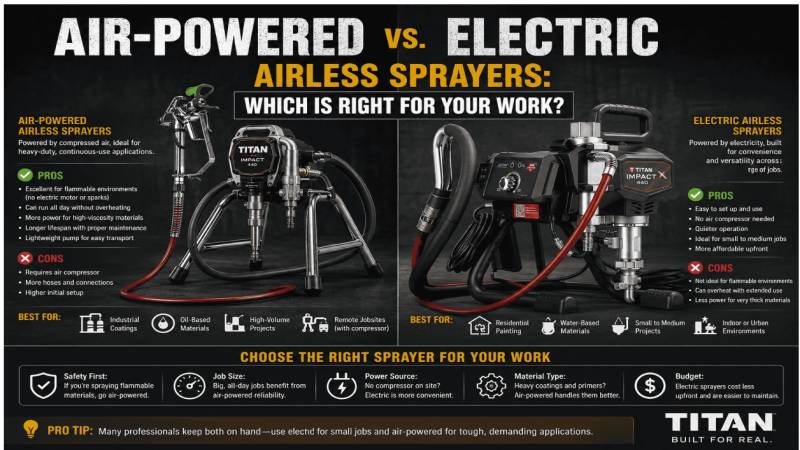
The question of air-powered versus electric airless sprayers comes up every time a contractor is expanding their equipment fleet or encountering a job type their current machine isn’t handling well. The answer is not universal — it depends on the work, the operating environment, and the materials being applied.
After more than two decades supplying parts and equipment to painting contractors, industrial coaters, and maintenance professionals across the country, we’ve seen both types of machines used correctly and used in the wrong application. This guide breaks down the genuine, practical differences between air-powered and electric airless systems — not from a spec-sheet perspective, but from the standpoint of how each performs in real job conditions and what that means for your maintenance, parts sourcing, and day-to-day operation.
How Each System Works — The Core Difference
Before comparing performance, it helps to understand what’s mechanically different between the two.
Electric Airless Sprayers
An electric airless sprayer uses a motor — AC on most professional units — to drive a connecting rod that creates reciprocating motion in the piston. The piston moves up and down inside the fluid section, drawing material in through the inlet valve on the upstroke and forcing it out under pressure through the outlet valve on the downstroke.
The motor, drive mechanism, and fluid section are a single integrated unit. Power the machine on, and everything runs together. The only external requirement is a power source — an outlet or a generator.
Air-Powered Airless Sprayers
An air-powered airless sprayer uses compressed air from an external compressor as its power source. The compressed air drives a pneumatic motor inside the sprayer unit. The pneumatic motor creates the same reciprocating piston motion as the electric motor in an electric machine — but without any electric components in the spray unit itself.
The fluid section of an air-powered machine works identically to an electric machine’s fluid section. Inlet valve, outlet valve, piston rod, packing — the same wear components performing the same function. The coating is atomized at the tip by hydraulic pressure, not by the air supply. The air is purely the power source for the pump motor. This distinction matters because it means the fluid section maintenance for both machine types is essentially the same.
Where Electric Airless Sprayers Win
Self-Contained Operation
The electric machine requires nothing beyond a power outlet. No compressor to transport, no air hose to run, no regulator to set, no compressor maintenance to schedule alongside sprayer maintenance. For residential work, interior projects, and any application where the machine moves frequently between rooms, floors, or job sites, the self-contained electric machine is faster to set up and simpler to operate.
Lower Total Equipment Investment
An electric airless sprayer for professional residential to light commercial use can be purchased for significantly less than an air-powered system when you account for the compressor required to run an air-powered unit. For contractors who don’t regularly encounter the conditions where air-powered systems excel, the electric machine is the economically correct choice.
Simplicity of Diagnostics and Maintenance
With an electric machine, the maintenance scope covers the fluid section wear components and the motor and drive system. With an air-powered machine, maintenance scope includes the fluid section, the pneumatic motor components, the air supply filtration system, and the compressor itself. For operations with limited maintenance resources, the simpler system is the more manageable one.
Where Air-Powered Airless Sprayers Excel
Continuous Duty Operation
This is the primary performance advantage of air-powered systems, and it’s significant for the right type of work. Electric motors generate heat under load. At high output rates, in hot environments, or during extended continuous operation, electric sprayers thermally limit — the motor protection system reduces output or stops the machine to prevent heat damage to the motor windings.
A pneumatic motor running on compressed air does not generate thermal load the same way. As long as the compressor maintains adequate air supply, an air-powered sprayer can run at full output continuously without thermal limiting. For high-volume industrial coating work — roof coating applications across large surfaces, elastomeric coating on commercial masonry, industrial maintenance painting at production rates — the ability to run continuously without thermal interruption is a genuine operational advantage.
Hazardous Environments
Electric motors produce sparks. In environments where flammable or explosive vapors may be present — fuel tank interiors, chemical containment coatings, solvent-heavy industrial environments — an electric motor in the spray unit creates ignition risk. An air-powered sprayer has no electric components in the spray unit. The electrical source is the compressor, which can be positioned outside the hazardous area with only the air line entering the work zone. This is why air-powered equipment is mandated by safety specifications in certain industrial coating applications.
High-Viscosity Material Handling
Air-powered sprayers designed for industrial applications — the Titan PowrCoat series, the Speeflo Commander, the Speeflo Admiral — are engineered specifically for thick, high-solids materials that smaller electric machines can’t handle at production rates. Elastomeric coatings, roof coatings, industrial enamels with high solids content — these materials require the flow capacity and duty cycle that purpose-built air-powered machines provide.
The air powered airless sprayer parts catalog at AllTitanParts.com covers the full Speeflo and Titan PowrCoat line with OEM service components for contractors who operate this equipment.
Remote Locations Without Reliable Power
When a generator isn’t practical — remote infrastructure work, pipeline coating, bridge maintenance in locations far from power infrastructure — a gas-powered compressor running an air-powered sprayer is the only reliable option for airless application. The combination is more logistically complex than a self-contained electric machine, but it functions where electric equipment cannot.
The Parts and Maintenance Comparison
Both machine types share the same fluid section architecture — piston pump, inlet valve, outlet valve, piston rod, packing. Wear intervals and replacement parts for the fluid section are broadly similar between equivalent-size electric and air-powered machines.
The meaningful maintenance differences:
Air-powered adds compressor maintenance. The compressor requires regular oil changes (on oil-lubricated units), air filter service, moisture separator draining, and periodic valve and pressure switch inspection. This is in addition to, not instead of, fluid section maintenance on the sprayer itself.
Air-powered adds air supply quality management. Contaminated air — carrying compressor oil or water vapor — damages the pneumatic motor and can contaminate the coating material if it reaches the fluid path. Proper air line filtration (moisture separator, coalescing filter, oil removal filter) is essential for air-powered sprayer operation and adds components that require periodic maintenance.
Electric adds motor and drive maintenance. The electric motor and drive mechanism require lubrication and occasional component service that air-powered units don’t have.
For contractors running either machine type, keeping airless sprayer parts on hand for the fluid section wear components — packing kits, inlet and outlet valves, suction filters — means the most common failure points can be addressed on-site regardless of which machine type you’re running.
Making the Decision
Start with the work, not the equipment.
What types of jobs make up your revenue? What materials do you apply regularly? What environments do you typically work in? The answers to those questions determine which machine type is appropriate — not the other way around.
If your work is primarily residential painting and light commercial applications, you spray standard coatings, and you have reliable power access on every job, an electric machine is almost certainly the right choice. Simpler, cheaper, more portable, adequate for the work.
If you do significant industrial or commercial coating work, regularly apply elastomeric or high-build products, work in environments with ignition hazards, or need sustained high-output operation over extended periods, air powered airless sprayer equipment is worth the additional investment and operational complexity.
Many established contractors run both — an electric machine handles the residential and lighter commercial work that makes up the majority of jobs, while an air-powered machine comes out for the industrial applications where its capabilities justify the setup cost. This is a practical approach that matches the equipment to the work rather than using one machine type as a universal solution.
Factor in the total ownership cost.
The initial price of the machine is the easiest number to compare but not the most important one. Total ownership cost includes equipment purchase, compressor cost for air-powered systems, maintenance costs over the machine’s service life, downtime costs from maintenance events, and the cost of work you can’t accept because the machine can’t handle the application. For the work types where air-powered excels, the total ownership cost of the right tool is lower than the total ownership cost of the wrong tool — even if the initial price is higher.
Nnanna Otuonye is the founder of AllTitanParts.com, an authorized OEM dealer of Titan, SprayTech, Wagner, and Speeflo airless sprayer parts located at 5250 Gulfton St, Suite 1H, Houston, Texas 77081. With over 20 years in the spray equipment industry, he supplies painting contractors and industrial coating professionals across the United States with genuine factory parts and same-day shipping.